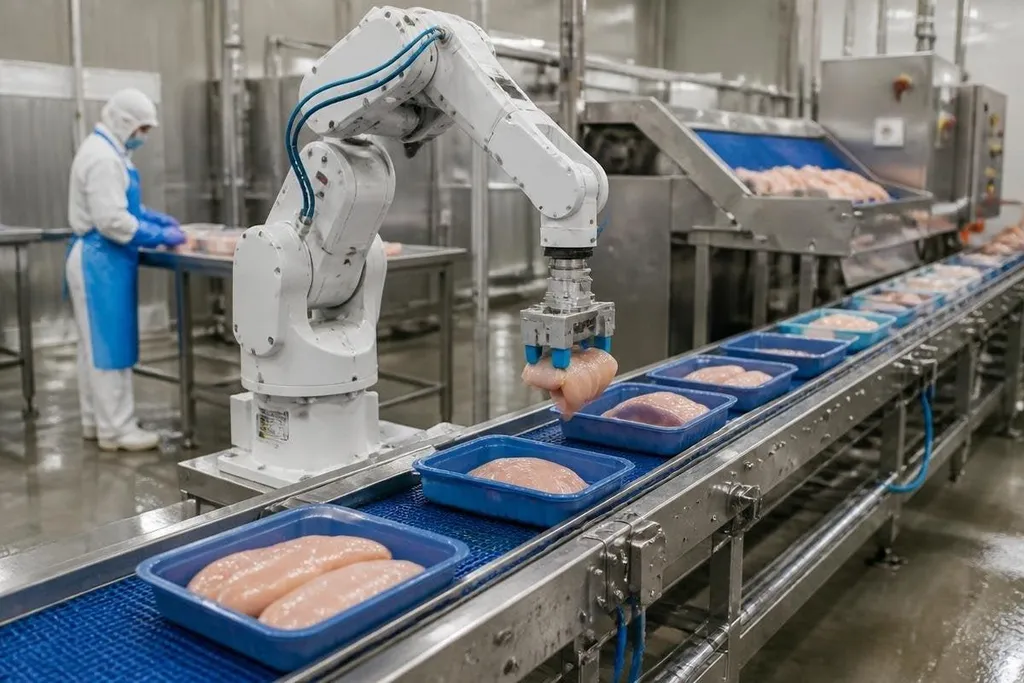
Food processing robots can move, sort, pack, inspect, and cut products in places where people face repetitive work or strict safety rules. Their value depends on the food, the washdown routine, and how well the robot fits the line around it.
- Robots can keep people away from sharp tools, cold rooms, and repetitive handling tasks.
- Food-contact parts need cleaning, inspection, and materials suited to the product.
- A system that works in a dry packing area may fail in a wet washdown zone.
Where robots help
The clearest use is repeated movement. It can pick items from a conveyor and place them into trays, cartons, or containers. That reduces repeated reaching for workers and gives the line a fixed pattern of motion.
The task still needs a suitable gripper. Soft food can tear under high force, while wet or uneven items can slip. A vision system may help the robot locate each item, but changing shape, glare, steam, and food residue can make that task harder.
Robots can also handle work near blades, hot surfaces, cold storage, or cleaning chemicals. Keeping people farther from those hazards can reduce exposure, though the robot cell still needs guards, sensors, and a clear stop control.
Inspection is another useful job. Cameras can check size, position, surface marks, or missing items as products move along a line. The result depends on lighting, camera placement, software settings, and the range of defects the system was built to find.
The food safety problem
Food plants place different demands on equipment than a dry factory. Robot arms, cables, seals, and covers may face water, heat, detergents, salt, sugar, oil, or acidic foods. A part that works well beside a conveyor may wear out faster after repeated washdown.
The robot also needs a cleaning plan. Food-contact surfaces should be easy to reach, inspect, and clean. Trapped moisture or product residue can create a sanitation problem, even when the robot still moves correctly.
Materials matter here. A food plant has to check the robot, gripper, belts, guards, and fasteners as one system. The machine maker's rating alone doesn't answer how the full cell will behave after daily cleaning.
That work adds time to maintenance. Staff need access to the robot, spare parts, cleaning instructions, and a way to confirm that the machine is ready before production starts again.
The cost beyond the robot
The purchase price is only one part of the decision. A food processor may also need a gripper, camera, conveyor changes, safety equipment, software, installation work, staff training, and cleaning checks.
The surrounding line sets the pace. If trays arrive at uneven intervals, the robot may wait or miss picks. If products overlap, the camera may not separate them. A fast arm cannot fix a poor handoff from the conveyor.
A food-processing robot needs more than a fast arm and a clean demo. Food processing robotics reports can tie the machine’s task to product size, line speed, changeover time, and human checks, giving you a clearer view of where it fits before food variety adds another test.
Food variety creates another limit. A system set up for one product may need new grippers, camera settings, or motion paths for another. Frequent changeovers can reduce the time available for production and cleaning.
I'd choose a food processing robot only after watching the full line run through cleaning, changeover, and restart. A short picking demo leaves too much out.
A practical buying check
Use this list before asking for a quote:
- Name the task: Write down the product shape, weight, surface, speed, and allowed contact points.
- Map the washdown: Record water pressure, cleaning chemicals, temperature, and how often staff wash the cell.
- Check the gripper: Test wet, dry, damaged, and poorly placed items instead of one perfect sample.
- Inspect access: Make sure workers can reach guards, tools, seals, emergency stops, and food-contact parts.
- Price the full cell: Add conveyors, vision, safety hardware, installation, training, spare parts, and service.
- Set a restart check: Define who confirms sanitation and machine status before production resumes.
The system can reduce repetitive handling and keep people away from some hazards, but it doesn't remove the work around food safety. The sound choice is the system that survives the plant's cleaning routine and still handles the product after the first changeover.